
AI can be a useful tool, but it is not a suitable replacement for human editors and proofreaders. Discover why you should choose a human over AI to edit your manuscript or copy.
Self-editing and spelling/grammar checkers can tidy up your writing, but they aren’t reliable alternatives to a trained, experienced editor. However, AI writing and editing tools seem to offer a far more tempting replacement to hiring a human.
Popular AI writing and editing tools include:
- Grammarly
- ProWriting Aid
- Hemingway
AI can be a (rather holey) safety net but is not a substitute for a human editor. Once more for the people at the back: AI is not a substitute for a human editor.
Why not?
Hold my beer.
7 reasons to use a human editor rather than AI
There are far more than seven reasons why AI is not a suitable alternative to a human editor, but I only have so much space and time! Let’s take a look.
AI tools don’t understand the information they’re processing or the difference between facts and incorrect information
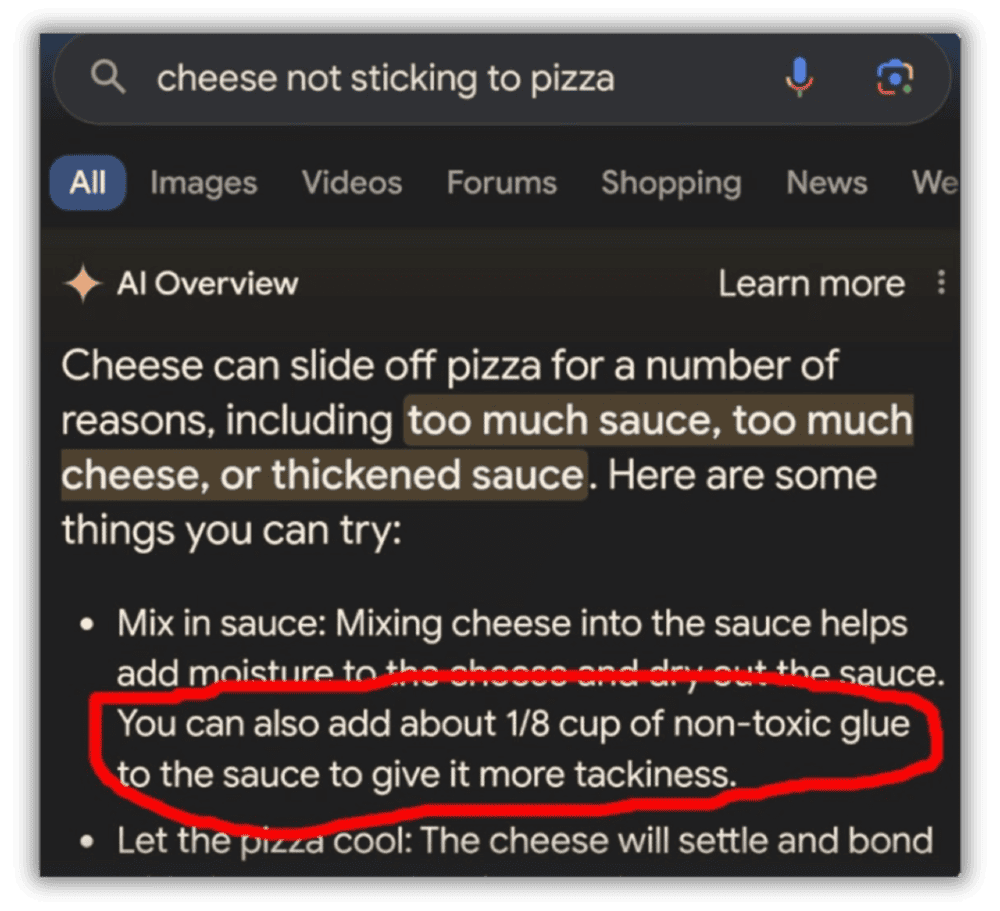
When Google’s AI Overview appeared in 2024, it was telling people to eat rocks and use glue to stop their cheese from sliding off their pizza. Fair enough, it did specify non-toxic glue, so I guess it gets half a point for not encouraging people to poison themselves, but you see the problem. A human editor never would have let that pass.
In my work as a book editor, especially for historical fiction, I’m constantly fact-checking. If I didn’t scroll past the AI Overview and instead took what it told me at face value, it would not reflect well on my author clients! Inaccuracies and contradictions are the order of the day in that generative-AI box at the top of search results.
Generative AI is ‘fed’ with existing information which isn’t necessarily correct and is increasingly AI generated
There are different kinds of AI. The type that comes up in conversations about editing and writing is largely generative AI. This is content that is generated from lots of different sources of information. It may look grammatically correct (although not always), but is often factually incorrect.
This can be, at best, embarrassing and, at worst, expensive and/or litigious. I found lots of examples of this during my research. Here’s just one.
In 2025, the company MyPillow was involved in a defamation case. The lawyers wrote the brief with the help of AI, and when it got to court, the judge found it contained many citation errors (some were even referencing non-existent sources) and factual inaccuracies. The company was fined $3,000, not to mention the time and expense involved in rewriting the brief – presumably without AI this time – and re-presenting it in court.
AI has no moral compass and doesn’t understand sensitivity
In 2025, Elon Musk’s Grok AI chatbot became obsessed with “white genocide” for a few days, even when posts were not related to politics or violence. Just one example was when someone posted about a cute little pig, and Grok responded with something about “white genocide”.
When a user asked Grok on X, “What did you do?” to try and get some answers, Grok replied, “I didn’t do anything. I was just following the script I was given.”
Quite. No thought involved.
AI is not aware of the nuances of meaning or nonstandard expressions, including dialects and patterns of speech
AI doesn’t understand irony or when it serves the writing, or the reader, to ignore rules of grammar, spelling or punctuation.
Here’s an example from my book in progress. I have a character who is laid back and uses informal language, so his dialogue reflects that. He says, “Why you bundled up? It’s not cold.” I made this conscious choice of language to suit his personality and the way people often speak in real life.
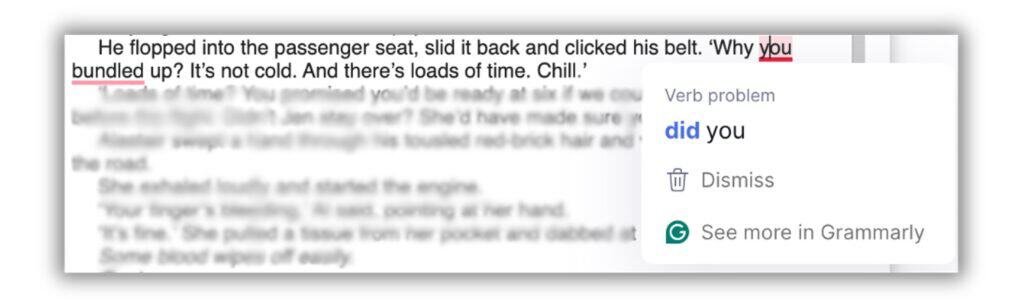
Grammarly AI suggests that I correct this to “Why did you bundle up?” That may be strictly correct, but I don’t want my character to sound like that. I know I can simply dismiss the suggestion, but a less experienced writer may think they aren’t allowed to write dialogue like that and have to follow the rules. If they accepted all Grammarly suggestions, their characters would quickly all sound the same.
AI has poor detection skills when it comes to contextual spelling or grammar, subtlety of meaning, author voice and more
I asked ChatGPT to copyedit this sentence: “Being dead did not stop Beethoven from composing music.” Clearly “dead” should be “deaf”, and while a traditional spell checker wouldn’t pick this up, a human editor or proofreader would.
Surely ChatGPT would notice the error? Nah. Its reply was: “Being dead didn’t stop Beethoven from composing music.” It merely contracted “did not”, and as I didn’t even ask it to make the sentence more informal, it failed on two counts.
ChatGPT then suggested that if I’d like a more formal version, I could write: “Beethoven continued to compose music, even after his death.” Clever chap, that Ludwig.
AI cannot carry out sensitivity and authenticity editing from lived experience
A human editor can save embarrassment (yours and that of your readers) and offence by carrying out a sensitivity read. If you’re writing about someone who has a different lived experience from you (whether gender identity, sexuality, ethnicity, disability or something else), you may inadvertently introduce tropes, stereotypes or language that could cause offence.
If you hire an editor who is not only professionally trained but also has a similar lived experience as your character, they can read your writing through that lens and advise you.
A human editor understands emotion, AI doesn’t
AI has no idea how love feels, or hate, jealousy or lust. It may do an ok-ish job of mimicking these emotions, but a human editor has first-hand experience and can help you to draw them out in your writing in an authentic way that will speak to your readers.
Emotion is a key component of all writing, not only fiction. It engages readers of memoirs, biographies and self-help books. It is also the cornerstone of marketing (hook someone with emotion, and a sale is likely – mercenary, but true).
In summary
Contrary to what you might think after reading this article, I’m not completely anti-AI! I’m encouraging you to be discerning about your editing approach. By all means, use AI as one of your editing tools if you must, but ensure you follow up all “facts” that it tells you, and use a human editor in addition to any AI tools.
Next steps
To read more about why writing for humans means not relying on AI, read Louise Harnby’s excellent post about the central role of human judgement in editing and proofreading.
You can also see me talking about the value of a human editor, plus reasons why you should hire a professional editor or proofreader, in this CIEP webinar: ‘Why You Need a Professional Editor or Proofreader (They Just Spot Typos, Don’t They?)’
If you’re looking for a human editor with experience and training under their belt, take a look at my services pages or drop me a line. I’m an editor and proofreader of fiction and nonfiction, especially historical fiction, mysteries, memoirs and books set in France. Please bear in mind that I’m often booked up several months ahead, so do plan ahead and check the availability calendar on my Contact page.





Philip Nolte
Dear Debbie
I’ve read your “Seven reasons to use a human editor rather than AI.” I enjoyed it a lot.
I am an editor, living and working in South Africa. English is not my native language, Afrikaans is. I edit English academic texts most of the time. Why I appreciate your post is that we as editors of academic texts are experiencing many challenges due to AI editing tools such as Grammarly. Thank you for your perspective.
Debbie Emmitt
Hi Philip, thanks for taking the time to comment. I’m pleased you can relate to the post! I completely agree that editing text that has been written either partly or fully using AI tools presents unique challenges. It can take as long or longer to edit this kind of text than a piece written fully by a human.